A protein has structure on several different scales. The primary structure of a protein is just the sequence of amino acids in its polypeptide chain. (Remember that a protein is made of one or more polypeptides, polymers made of amino acid monomers that are bound together end-to-end to make a long chain.) The primary structure of a protein is related to the sequence of messenger RNA by the genetic code. (Remember: DNA goes to mRNA goes to protein--with some notable exceptions that I can talk more about if you want.) So we can design a protein with any primary sequence that we want by making a gene with the appropriate DNA sequence.
Proteins aren't just strings of amino acids, though. That would be boring and probably useless. Instead, proteins fold into complicated three-dimensional structures. Some of these structures occur again and again in different proteins. These basic motifs that occur again and again form what is called secondary structure. There are several different common secondary structures:
- The alpha helix is a corkscrew-like arrangement of amino acids that forms because of bonding between every fourth amino acid in the sequence. (Hydrogen bonding to be specific.)
- The beta sheet is a sheet-like arrangement formed by parallel segments of the polypeptide chain. Beta sheets are formed by another type of hydrogen bonding between amino acids in neighboring chains.
- Other secondary structures: The alpha helix and beta sheet are probably the most common secondary structure motifs. Other secondary structures include turns and weirder types of helices like the 310 helix and the polyproline helix.

No human being (at least no one I know!) can easily predict what secondary structure a protein will be in just by looking at its primary sequence. However, people have created sophisticated computer programs that predict secondary structure. Here are some examples. These programs sometimes work very well, but they aren't foolproof. Often, the secondary structure of a particular segment is strongly influenced by interactions with other parts of the protein. A segment of the polypeptide chain that forms an alpha helix in the full protein, for instance, may not form an alpha helix when it is on its own.
And that brings us to tertiary structure. Tertiary structure is how all of the amino acids in the polypeptide chain are arranged in three dimensions. The three-dimensional structure of each protein is extremely important for determining how it will function in the living organism. Unfortunately, predicting how a protein will fold into its tertiary structure is very, very hard. However, it is known that the information about how a protein will fold is somehow stored in its primary sequence of amino acids. People have done classic experiments to show that small proteins can refold on their own after being unfolded by chemical treatment.
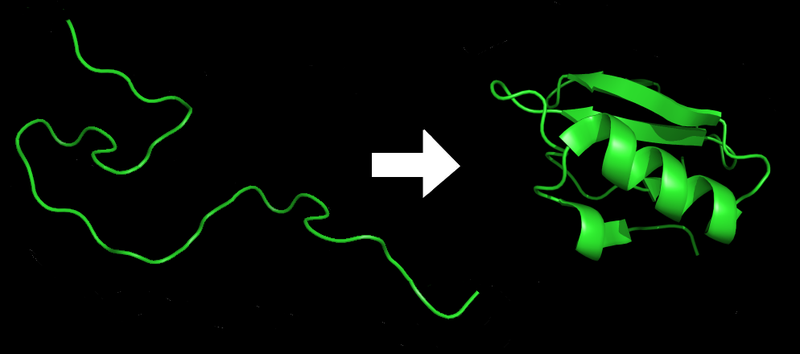
A protein typically folds into a well-defined structure determined only by its amino acid sequence.
But how can we predict how it will fold? This is a huge problem!
So how can we decode the information in the protein's sequence of amino acids to determine how it will fold in three dimensions? This is a question that scientists are still trying to answer, though most agree that the answer will have something to do with making computer models of protein structure and protein folding. More on that next time...


